

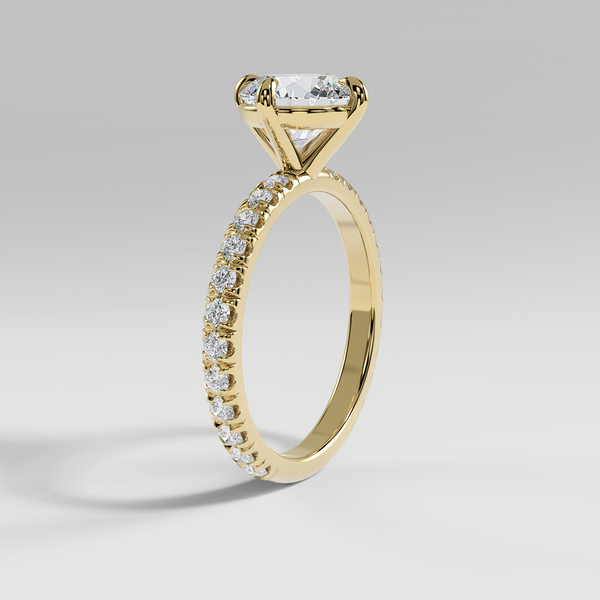


You just got your ring appraised, and the number on the document is higher than what you paid. Maybe a lot higher. You've probably wondered how they landed on that number. Is it arbitrary? Is someone just making it up?
It's not arbitrary. I've been making jewelry for years, and understanding this system has saved my clients real money. Let me break it down.
It Starts With the Diamond, and the 4Cs Aren't the Whole Story
Most people have heard of the 4Cs: carat, cut, color, and clarity. They're the foundation of diamond grading, and yes, they directly drive appraisal value. But here's what most buyers don't know: the relationship between the 4Cs and price isn't linear. It's steep in some places and almost flat in others.
Take color. With lab-grown diamonds, the price difference between a D and an E is relatively small, because the production process makes top color grades far more accessible than in the mined market. The gap widens once you drop into the I and J range, where the stone starts showing warmth you can see with the naked eye. That's exactly why our lab-grown diamond inventory is held to a strict D–F color floor. You're not paying for a marginal grade bump. You're paying for a stone that genuinely looks exceptional.
Cut is where it gets even more interesting. A poorly cut diamond can have perfect color and clarity and still look lifeless. Cut determines how light travels through the stone: how it bounces, refracts, and exits back through the top. An excellent cut grade means the stone was faceted to maximize brilliance.
A dull diamond is a waste of money, no matter what the certificate says about the other three Cs.
For an appraiser, these factors combine into a market comparison. They look at what a comparable stone sells for at retail right now, and that becomes the baseline for your appraisal.
Myth vs. Fact
Myth: 18k gold is pure gold.
Fact: It's 75% gold. Pure 24k gold is too soft to hold a diamond securely in a ring you wear every day.
Myth: White gold and platinum are the same thing.
Fact: White gold is gold mixed with white metals, usually plated for extra brightness. Platinum is naturally white all the way through.
The Metal Matters More Than People Think

The stone gets most of the attention, but the metal it's set in contributes meaningfully to appraised value, and it moves more than most people realize.
Gold is priced by weight and purity. An 18k gold ring is 75% pure gold by weight. That metal content is real, it fluctuates daily on commodity markets, and it shows up directly in an appraisal. Gold has hit record highs recently and sits at nearly double where it was just a few years ago. A ring appraised a few years ago could legitimately appraise much higher today with zero changes to the stone, simply because the metal is worth more.
Platinum has a well-earned reputation for rarity and durability. It's the most wear-resistant precious metal used in fine jewelry. It doesn't thin out the way gold does over decades of daily wear, and its density means prongs and settings hold stones more securely over time. For someone who wants a ring that physically outlasts everything else, platinum is the honest answer.
Every Mad Minerals engagement ring is crafted in 18k gold as standard, in white, yellow, and rose, as well as platinum, so you can choose a metal that fits both your style and how you live.
Craftsmanship: The Factor No One Talks About
This one is underappreciated, and it's where mass-produced jewelry quietly loses value compared to handcrafted pieces.
An appraiser doesn't just look at the stone and the metal. They assess the quality of the setting, the precision of the finish, the integrity of the prongs, and the overall execution of the ring. A poorly set stone, with uneven prongs, tool marks in the metal, or an inconsistent finish, will appraise lower than an identical ring made with precision.
A client recently brought me a pendant that was a perfect example of cutting corners. The design was poor, the setting was sloppy, and the metal was so thin it would bend under normal wear. It was also nearly impossible to clean because of how the setting was built: dirt and debris had nowhere to go. Whoever made it skimped on gold to hit a lower price and make the sale.
The piece looked cheap because it was cheap. Not because of the stone, but because of the decisions made at the bench.
I remade it. Proper metal weight, a clean setting, a design that actually works for the stone. The difference was immediately visible. That's what craftsmanship means in practice, and a certified appraiser will see every one of those shortcuts under a loupe.
Geographic Market: Yes, It Affects Your Number
Something most people don't consider: the same ring can appraise differently depending on where you are.
Appraisers use local and regional retail data to set replacement value. In high-cost cities like Toronto, Vancouver, New York, or Los Angeles, where luxury retail rents are high and demand for fine jewellery is strong, replacement costs are higher. An appraiser in Toronto is comparing your ring against what Toronto retailers charge.
That doesn't mean your ring is worth more or less as an object. It means replacing it in your market costs more. For insurance, that matters: if you live in Vancouver and your ring is lost, you're replacing it at Vancouver prices.
For Canadians, the exchange rate plays a role too. Most diamond wholesale pricing is in U.S. dollars. When the Canadian dollar weakens, as it often does, the CAD replacement cost of your ring rises even if diamond prices haven't moved at all. It's one of the less obvious forces quietly pushing appraisal values up over time.
From the Bench: Same Rings, Two Quotes
A client and his fiancée came to me after visiting a well-known local jeweler, a big name with an established store. They had a clear vision: a 2 carat total oval half-eternity engagement ring, a gold wedding band for her, and a solid gold band for him. The store had already given them a quote.
Before they told me the number, I priced out the whole project based on what they wanted. When we compared, I came in substantially lower for the same quality, the same metals, and the same stones.
They didn't come to me just because I was more affordable. They came because they'd heard my quality was worth it. The price difference was just the confirmation they needed.
How Mad Minerals Pricing Actually Works
Understanding appraisal value means understanding where your money actually goes when you buy a lab-grown diamond engagement ring in Canada. Where Mad Minerals is different is the diamond. Our prices don't carry the showroom and marketing overhead of the big retailers, so the stone costs you far less. On a stone that would retail elsewhere for far more, that gap is significant, and it shows up directly in your appraisal, because replacement value reflects what the market charges, not what you paid.
Keep Your Appraisal Working for You
- Update it every two to three years, or sooner if gold prices jump.
- Keep your grading certificate and a few clear photos of the ring with it.
- Add the ring to your insurance as a scheduled item, not just general contents.
- Get a fresh appraisal after any work that changes the ring, like a new setting.
The Bottom Line
A jewelry appraisal is a snapshot of replacement value, built from your stone's grades, your metal's current market price, the quality of the craftsmanship, and the retail conditions where you live. None of it is arbitrary. It's a structured evaluation by a trained professional using real market data.
Understanding these factors means you can make smarter decisions before you buy. When you're ready, browse our engagement ring collection and diamond inventory and see exactly what you're getting before you commit to anything.
Ask the Jeweler
Got a question about a diamond you're looking at, or a ring you already own? Send it to me. I answer the best ones right here in Questions Before the Big Question.
Start from the beginning of the series: Why Lab-Grown Diamond Pricing Is More Confusing Than It Needs to Be, and Who Benefits From That →
Questions Before the Big Question: the Mad Minerals blog series.
About the author
Jeffery founded Mad Minerals in 2018 in Montreal to make high-quality lab-grown diamond engagement rings and custom jewellery. He writes The Loupe to answer the questions people actually ask before they buy.